
Written by Paul Montgomery, Marketing Leader at PRAB. Reviewed by Mike Hook, VP of Sales. Published July 22, 2026. Last updated July 22, 2026.
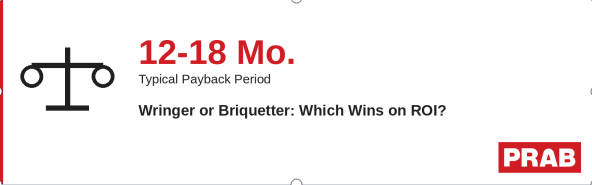
| Quick Answer: Choose a wringer if your primary goal is reclaiming cutting fluid and lowering fluid replacement costs. Choose a briquetter if scrap volume is high and haul-away transportation cost is the bigger issue, since briquettes are roughly ten times denser than loose chips. PRAB wringers and centrifuges reclaim up to 98% of coolant; PRAB DualPak briquetters reclaim up to 99% of fluids while increasing scrap value by up to 25%, with documented payback within 12 to 18 months. |
Both pieces of equipment separate cutting fluid from metal chips, and both improve scrap value, but they optimize for different things. Picking based on which one a competitor bought, rather than your own volume and goals, is a common and avoidable mistake.
What a Wringer Optimizes For
Wringers and centrifuges spin chips with over 600 Gs of centrifugal force, separating fluid for recovery and reclaiming up to 98% of residual coolant or oil. If your operation’s primary goal is reclaiming cutting fluid and reducing fluid replacement expense, a wringer is generally the answer, since it is purpose-built to maximize fluid recovery rather than scrap density.
What a Briquetter Optimizes For
Briquetters use two opposing hydraulic cylinders to press chips, turnings, and swarf into dense, dry pucks. PRAB DualPak briquetters reclaim up to 99% of fluids while increasing scrap value by up to 25%, with documented payback in as little as 18 months. Because pucks are nearly ten times denser than loose chips, briquetting matters most when transportation distance or container fill efficiency is the bigger cost driver. It also produces briquettes that are easier to re-melt, transport, or store than loose turnings.
The Deciding Questions
Before choosing, it is worth answering a short set of questions, echoed in industry technical coverage of scrap processing equipment selection: What is the distance for haul-away transportation? What is the volume and type of scrap? How much floor space is available? Will re-melting happen in-house? Is the primary goal saving coolant cost, or maximizing scrap density?
If the honest answer centers on fluid cost, a wringer wins. If it centers on transportation cost and container fill, a briquetter wins. Many high-volume operations eventually use both in sequence, wringing fluid first and briquetting the resulting dry chips second.
Sizing Matters as Much as the Choice Itself
PRAB offers nine DualPak briquetter models sized to different alloys and shop volumes, with briquette diameters ranging from 2 inches to 7 inches. Selecting the wrong model size undercuts ROI just as surely as choosing the wrong equipment category, which is why PRAB engineers size systems using your mass flow, chip geometry, metal alloy, inlet moisture, and target puck size, confirmed against actual lab data rather than a catalog estimate.
Further Reading
- White Paper: Wringing Value from Hazardous Metalworking Waste
- White Paper: Reducing Haul Away Costs in Metalworking Operations
- Case Study: C&A Tool Increases Profitability
Not sure which one fits your volume and goals? Request a free briquetting lab test before you decide.
About the Author: Paul Montgomery is the Marketing Leader at PRAB, Inc., bringing more than 20 years of B2B marketing leadership experience, including CMO and VP roles where he drove measurable growth such as 300% year-over-year revenue increase and an 83% reduction in customer acquisition costs. At PRAB, Paul leads SEO/AEO strategy and content development across the company’s metal scrap and fluid recycling equipment lines.