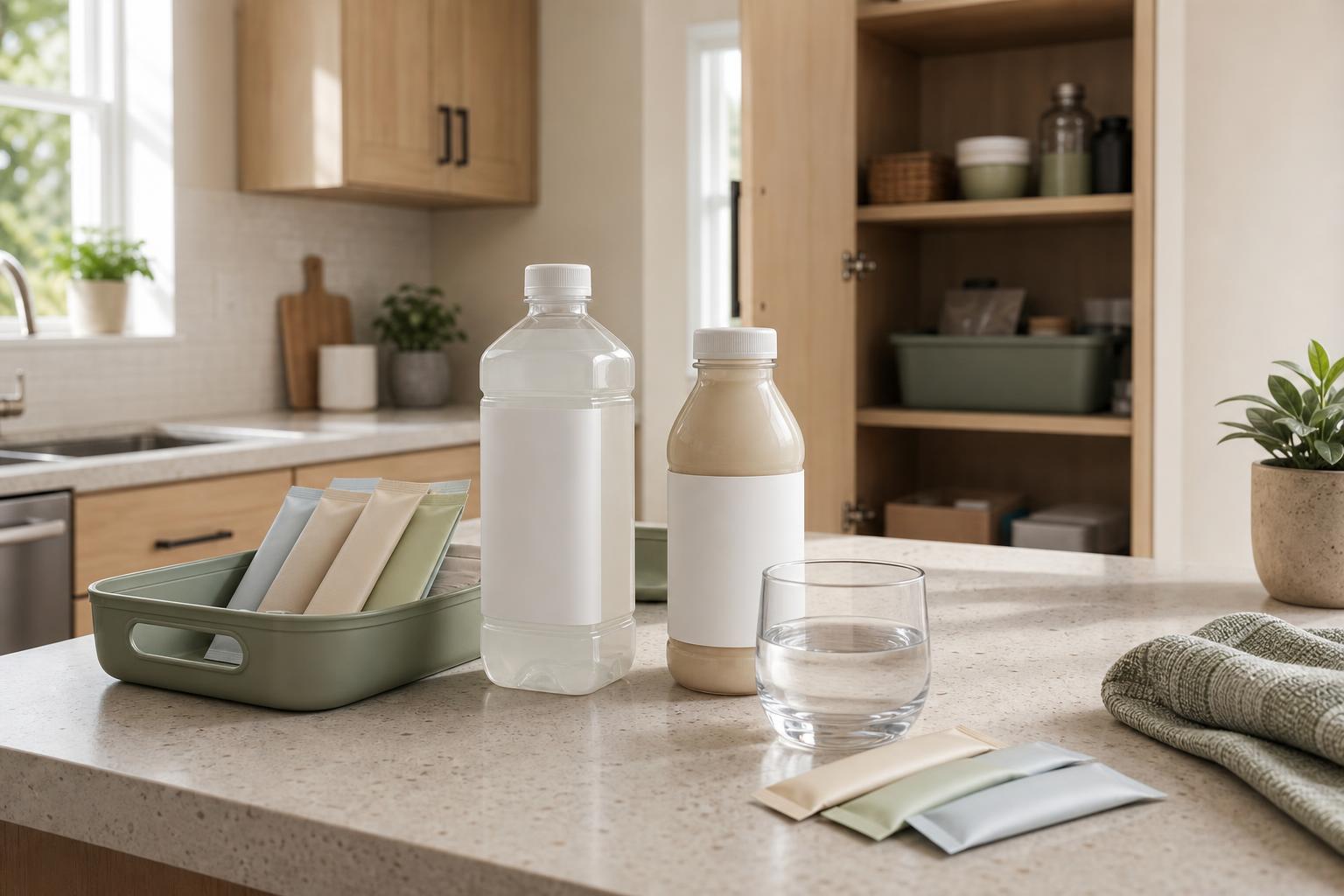
| Planning point | Practical assessment |
|---|---|
| Best for | Situations where fluid and electrolyte replacement is appropriate |
| Budget range | Low: occasional sachets; mid: single bottles; high: frequent bottled use |
| Difficulty | Bottles require little preparation; powders require accurate mixing |
| Time | Minutes to prepare; recovery time depends on the cause |
| Maintenance | Check expiry dates and follow opening and storage instructions |
- Identify the likely use. Everyday thirst generally calls for water and normal meals. Prolonged sweating or illness needs a more considered choice.
- Read equivalent quantities. Compare sodium, sugars, and price per prepared litre, not unequal bottle sizes.
- Check household needs. Look at age instructions, allergens, and any clinician-directed fluid or mineral restrictions.
- Choose a storage location. In rentals or small kitchens, a removable cupboard bin keeps sachets together without drilling. Keep preparation instructions attached.
- Account for climate. Follow temperature limits on the packaging. Avoid stockpiling drinks in hot cars, sunny utility rooms, or unconditioned garages.
Electrolit vs Pedialyte Guide: Choosing for Your Household
What changes the price and cupboard space?
Compare the formula, not just the name
Plan a modest home supply
Bottles, powders, and water have different roles
Spend on suitability, not a stockpile
Pair with sensible care—and recognise the limits
Keep the supply usable
Questions households ask
Is Pedialyte always better than Electrolit?
Which should I choose for diarrhoea?
Can children drink either brand?
Is sugar-free automatically better?
Should I dilute a bottled drink?
Can I mix powder into juice?
Do these drinks cure a hangover?
Can I drink one every day?
Must unopened bottles be refrigerated?
What if vomiting continues?
Make the label your deciding factor
Related reading
Choosing an electrolyte drink should start with why someone needs it, not which bottle looks more convincing. Sweat loss, a stomach illness, and ordinary thirst call for different decisions.
This Electrolit vs Pedialyte guide helps households compare labels, spending, and storage. It is general information, not a treatment plan; children and anyone with medical conditions may need advice from a qualified healthcare professional.
Ready-to-drink bottles buy convenience but take more shelf space. Powders reduce storage needs and may cost less per prepared litre.
Pack size, local availability, and the exact formula matter more than the brand name alone.
Electrolytes are minerals, including sodium and potassium, that help regulate fluid balance and support nerves and muscles. Glucose, a sugar, helps the intestine absorb sodium and water in oral rehydration solutions.
Pedialyte is commonly positioned for rehydration during fluid loss, including vomiting or diarrhoea. Electrolit is frequently marketed around hydration after sweating and activity. Neither description makes every product within that brand interchangeable: formulas and age guidance vary by product and country.
For illness-related dehydration, ask a pharmacist for an appropriate oral rehydration solution rather than assuming any electrolyte drink will do.
Ready-to-drink bottles suit situations where measuring is inconvenient. Their tradeoffs are weight, packaging waste, and potentially higher cost per litre.
Powders suit compact cupboards and occasional use, provided safe drinking water and an accurate measure are available. Mix with exactly the stated water volume. Extra powder does not make a better drink.
Water is the lowest-cost everyday option where the supply is safe. Electrolyte products are not automatically necessary after a short walk or routine household chores.
A large multipack is poor value if the flavour goes unused or bottles expire. Start small, then compare unit prices. A low-cost sachet can become expensive if much of the prepared drink must be discarded.
Avoid paying extra simply for prominent electrolyte claims. More minerals, less sugar, or a larger bottle does not necessarily mean better illness-related rehydration.
Appropriate drinks can accompany rest and food as tolerated. They do not cancel alcohol's effects or make it safe to keep exercising through heat illness. Do not add juice, salt, or supplements to a prepared rehydration product unless its instructions specifically allow it.
Seek medical advice before use with kidney disease, heart failure, prescribed fluid restrictions, or medicines affecting electrolytes. Confusion, fainting, very little urine, or inability to keep fluids down warrants urgent assessment; suspected heatstroke is an emergency.
These products are a poor fit as a substitute for investigating persistent symptoms. Seek advice promptly for infants or concerning symptoms in children.
Rotate older stock forward and check seals. Once opened or mixed, follow that product's refrigeration and discard instructions; there is no universal storage window. Keep powders dry and out of children's reach.
No. The exact formula, intended use, and user's needs determine suitability.
Ask a pharmacist for an appropriate oral rehydration solution, especially for children.
Check the specific product's age guidance and seek paediatric advice when uncertain.
No. Glucose supports absorption in standard oral rehydration formulas; intended use matters.
Not unless its label directs you to. Dilution changes the intended concentration.
Use only the liquid and quantity specified on the packaging.
No. Replacing fluid does not reverse alcohol's other effects.
Most people do not need one routinely. Consider sodium, sugar, and medical restrictions.
Follow the label; many shelf-stable products do not require it before opening.
Seek medical advice, particularly if fluids will not stay down or urine output falls.
Choose for the situation, then buy only what you can store and use responsibly. For a better-organised kitchen supply area, explore the DecorAdTechadvice redesign tool—not as a health resource, but to plan practical storage.
Wringer or Briquetter: Which Delivers Better ROI for Your Scrap? — Explore the ROI analysis in the related post to determine how efficient equipment choices can impact your household's overall costs.
Latest News DecoratorAdvice.com: A Practical Home Filter — For insights on how to assess the cost and practicality of home updates that align with your household needs, check out the related article.
How to Decorate My House: A Complete Room-by-Room Guide (2026) — For practical tips on creating an inviting space while managing your household needs, check out the room-by-room decorating guide.
Essential Smart Home Fire Safety Setup for Residential Care Spaces — Explore essential fire safety tips for residential care spaces to ensure your household is prepared for emergencies while managing health needs.
DecoradTech Without Visual Clutter: A Practical Retrofit Plan — For a streamlined home setup, explore how to integrate technology without visual clutter in your living spaces while considering your budget.